For more background information and bibliography: Visit this page
If you don’t like companies taking on the world by themselves and prefer a more sensible approach, See part 3, for strategy B
Finally, if you want to skip the chase and straight up compare the two, go here.
Strategy A: Disruption through a fully integrated model
The disruption strategy focuses on building a vertically integrated system that challenges the limitations of traditional MSK diagnostics. The goal is to deliver a lower-cost, scalable, and more accurate alternative directly to the user.
This is achieved through a subscription model, where customers receive both the hardware and download an accompanying mobile app. The proprietary sMMG tapes connect wirelessly with the app, allowing users to collect diagnostic data in real-world environments. A short onboarding process trains users to apply the tapes correctly.
Once the system records initial data, Figur8’s proprietary AI analyzes muscle movement patterns and identifies underlying issues. Based on these insights, the app recommends personalized corrective exercises. Users can then track their progress over time, closing the loop between diagnosis, intervention, and recovery within a single platform.
Unlike traditional systems that require expensive lab equipment and expert interpretation, Figur8 offers a self-contained alternative that is more objective, accessible, and convenient.
Customers
Who is the Customer when disrupting?
Are there enough people with this issue? People over 30 are probably laughing at that question.
MSK conditions are common and frequently misdiagnosed. Lower back pain affects 30–40% of adults. Around 25% of adults in North America have experienced moderate to severe MSK pain, and most have had at least brief episodes (El-Tallawy et al., 2021). An estimated $31 billion is spent annually on physical therapy to assess, diagnose, and treat movement dysfunction (Yelin & Cisternas, n.d.). While various therapies exist, exercise is typically the first line of defense for both new and chronic moderate pain.
Thus, there is a large market of adults with chronic MSK pain that Figur8 can access.
How do we enter this market?
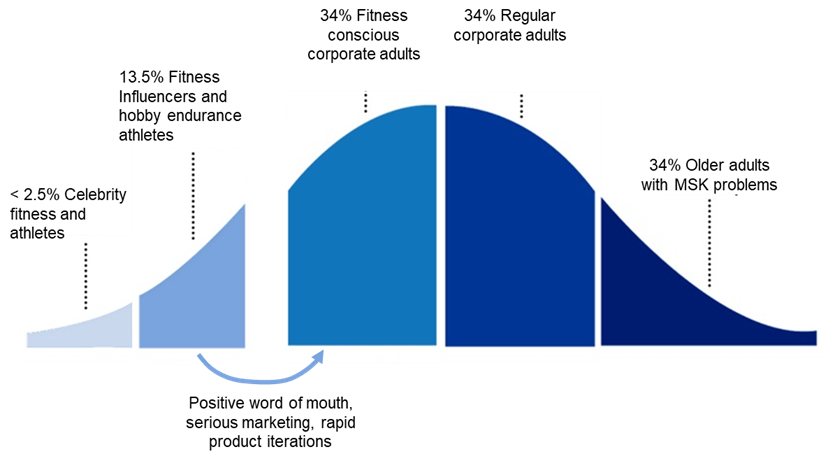
Figur8’s initial entry point should be beachhead customers: performance athletes and celebrities. These individuals lead highly active lives and are open to experimental systems. While many are already served by traditional providers, Figur8’s unique ability to collect real-time, field-based data may offer them enough value to switch. Early endorsements from this group can build awareness quickly.
The larger innovator group will include fitness influencers and celebrity trainers who regularly monitor their health and MSK data. They can help showcase the system’s benefits in improving mobility and managing fitness-related injuries.
Early adopters are likely to include local trainers, marathoners, and fitness enthusiasts who train at least five times a week. Their feedback will be essential in refining the product for the broader early majority. Attention should be given to program completion rates, pain reduction, performance improvements, and overall satisfaction. These key metrics should be gamified to drive user engagement.
Celebrity endorsers and influencers will also help attract the early majority. Figur8 can partner with fitness and wellness apps like MyFitnessPal or Runtastic (which had 6 million monthly users in 2013) to expand its reach.
These partnerships will require strategic relationship building and strong marketing execution. As the focus shifts from innovation to growth, Figur8’s go-to-market strategy must evolve accordingly
To win over the middle of the adoption curve, Figur8 can use subscription pricing to reduce the upfront hardware cost. While innovators may pay out-of-pocket, the early majority will likely prefer bundled subscriptions that include hardware, diagnostics, and personalized MSK exercise plans. This segment includes time-strapped professionals who exercise three or more times a week and want efficient, data-backed training support.
Once early majority adoption is achieved, MSK care will start to feel more mainstream. The late majority—who exercise less frequently and are focused on pain prevention rather than performance—will begin to adopt.
The final segment, laggards, includes older adults (50+) with chronic MSK issues that can be managed but not reversed. Although they may benefit the most, they may also be the hardest to convince due to a perceived learning curve or discomfort with technology.
Technology

When pursuing a disruption strategy, the company controls its own integrated value chain and serves a niche segment that is underserved by incumbents. It does so through ownership of a novel technology.
The old S-curve of existing tech started flattening a while ago, and Figur8 has innovated to position itself on a new technical S-curve that is currently unexploited by other digital MSK management companies. Under this strategy, Figur8’s system would be incomplete without a user-friendly interface and a data processing AI algorithm capable of accurate diagnosis. While Figur8 is already backed by scientific research and is in the process of receiving approvals, it must be ready to iterate as more data is collected from its early users to strengthen its value chain.
Fortunately, Figur8 will have access to user data, which can be used to improve the predictive power of its AI algorithm. Feedback on the accuracy of predictions can be gathered directly through the software component the user interacts with — the mobile app. App reviews can also serve as a valuable data point for measuring satisfaction. User surveys, emails, and social media platforms can help close the feedback loop. This feedback cycle will be essential for serving the early and late majority, allowing Figur8 to grow with — or ahead of — the market.
It is critical that the company designs the system to minimize ambiguity. Customers could injure themselves if they misinterpret unclear instructions or diagnoses. Figur8 will need to invest in effective communication of results, ensuring that outputs are easy to understand and not overly technical.
Company performance will ultimately depend on which S-curve Figur8 is on.
- Since the hardware is already developed and significant progress has been made in software, Figur8 can limit its current focus to a defined set of MSK conditions and bring the product to market. Even with the existing capabilities, execution is key. A well-functioning supply chain is required to produce high-quality products at scale.
- Over time, Figur8 can continue to innovate by expanding the range of MSK issues the system can address. This will help extend the company’s growth curve, even without major upgrades in hardware, although progress will eventually slow if the company moves into rare conditions that are harder to detect through movement patterns.
- Revenue generated from early adopters can be reinvested to expand the product suite. In the long term, Figur8 may be able to offer a range of at-home biomarker measurement tools, including more advanced MSK diagnostics.
Information available on Figur8’s website suggests that hardware development is largely complete, and the current focus is on refining the diagnostic system. This is encouraging, as long-term technical growth will depend on continued investment in AI development. As early revenue comes in, it will give Figur8 the resources it needs to keep innovating.
Competitive Strategy
Competitive Landscape
Figur8 currently has no direct competition from incumbents, which is typical for startups that follow a disruption strategy.
There are two categories of incumbents in the MSK space that could be considered indirect competition:
| Type | Example | Pros | Cons |
|---|---|---|---|
| Equipment makers for MSK diagnostics | Dantech, EMS Biomedical | Industry-standard tools | Expensive, outdated technology; no direct access to end users |
| Digital MSK health service integrators | Hinge Health, Sword Health | Integrated into existing value chains | No proprietary diagnostics technology; rely on human or telehealth-based interpretation |
The first group offers accurate, personalized diagnostics, but they are expensive and confined to clinical settings. These systems are not designed for field data collection and are out of reach for most people.
The second group provides MSK care through employer-sponsored health plans. Their value lies in reducing workplace injury and managing recovery to lower insurance premiums (Hinge, 2020). However, this model depends on employment status and employer-insurer relationships, making availability inconsistent. Additionally, these services rely on human interaction via video calls, which can be limited by camera quality and poor angles.
Figur8 does not fit neatly into either bucket. Most importantly, it owns proprietary hardware that enables a fundamentally different approach to MSK diagnosis. By removing cost and subjectivity from the process, Figur8 introduces a new diagnostic method that incumbents have not pursued, giving it a long-term competitive advantage.
Competitive Strategy – Compete Rather Than Collaborate
Because Figur8 controls its value chain, it must position itself to pull attention away from incumbents. Even with a superior product, market inertia is a real challenge.
The company must invest in marketing and brand-building to establish its presence. There is also no mention of a customer experience team, which is critical in a disruption strategy. This is where early adopters and innovators become essential — they will serve as the first wave of champions who draw others into the ecosystem.
Execute Rather Than Control
Figur8 has already spent significant time developing its hardware and building out its software. To complete the disruption model, it now needs to invest in the operational elements of the value chain: service logistics, marketing, product management, and customer care.
Revenue will initially come from selling hardware–software bundles to early adopters. As the company moves deeper into the market, it can switch to a subscription model. This will not only help attract new customer segments but also generate recurring revenue to fuel ongoing innovation and maintain its position on the best S-curve.
Organization
Figur8 has built a strong technical foundation with a functioning product and scientific validation. However, since the product has not yet been launched widely, the organization appears to be structured more like a lab than a go-to-market company.
This makes sense given the stage Figur8 is in. A strong founder and a team with deep scientific knowledge were necessary to prove the product’s core technology. But now that the foundational work is complete, Figur8 needs to evolve. It must shift its organizational focus to commercial execution.
The current team includes a CEO with an MBA, a CTO with an academic background, and a CPO with a strong record of building health platforms. These three leaders will need to recruit key roles for the next phase of growth, including:
- Product management – to shape the roadmap, prioritize features, and manage trade-offs across user needs and technical complexity
- Operations and logistics – to ensure reliable manufacturing, packaging, and delivery of the hardware
- Customer experience – to support onboarding, improve usability, and drive user retention
- Marketing and community – to create awareness, build partnerships, and amplify early customer stories
- Data science / AI – to refine the diagnostic engine using real-world data
Since Figur8 will be operating in the healthcare space, it must also put in place a legal and compliance team. This will be important not only for meeting regulatory requirements, but also for building trust with users who are sharing sensitive health information.
As the company scales, cross-functional collaboration will become increasingly important. For example, insights from customer support should feed into product design; data from diagnostics should inform marketing content. This feedback loop can only work if teams are aligned and communication flows smoothly.
In short, Figur8 must now build the capabilities of a startup ready for scale. The shift from research to execution is not just a product shift — it's an organizational one.
Profit Formula
Figur8’s profit formula will evolve in stages as the product moves from niche to mass adoption.
In the early stages, the company will likely generate revenue by selling the hardware–software bundle to innovators and early adopters. These customers are willing to pay upfront for new, specialized solutions. This one-time purchase model will help Figur8 recover its R&D and manufacturing costs.
As the company matures and expands into the early majority, it should shift to a subscription-based model. This reduces the barrier to entry for new customers and creates a recurring revenue stream. The subscription could include:
- Access to the mobile app and diagnostic AI
- Periodic updates to exercise routines
- Progress tracking and insights
- Optional consultations with MSK specialists (if offered in the future)
A bundled subscription model will be particularly appealing to users who are not motivated solely by performance but by the desire to manage pain, improve mobility, and stay active. This aligns with how most people think about health — they want simple, effective tools that integrate into their routines.
As usage grows, Figur8 will also benefit from network effects and data scale. More users mean better AI training data, which leads to more accurate diagnostics and better recommendations. This improves the core product without proportionally increasing costs, enhancing long-term margins.
In addition, partnerships with fitness apps, insurance companies, or physical therapy platforms could open up new monetization paths. For example, integrating Figur8 data into wellness platforms or corporate health programs may justify enterprise pricing or B2B licensing models.
Over time, a mature version of Figur8’s business model may include a mix of:
- Consumer subscriptions
- Hardware sales (initial or ongoing)
- Institutional partnerships
- Data integrations and insights (with consent and proper safeguards)
Ultimately, Figur8’s profitability will depend not just on how many people it reaches, but on how successfully it turns its diagnostic insights into ongoing value — for users, providers, and potential partners.
Value Creation Hypothesis
Figur8 creates value by enabling objective MSK data collection while the user is in action, outside the confines of a lab. When integrated with its software platform, this system is cheaper than existing technology and more accessible than incumbent value chains.
It serves adults suffering from MSK issues due to long desk hours, as well as fitness-conscious individuals who are recovering from injuries or looking to improve performance. The majority of this population is underserved by current options, and many will likely be willing to pay for a subscription-based service that helps monitor and manage their MSK health.
Value Capture Hypothesis
For Figur8, the key resource that Figur8 controls is its hardware, which is unlike anything currently available in the market.
Disruptive ventures capture value by growing its customer base without prompting a focused response from incumbents. Whether this will hold true for Figur8 is uncertain. Its technology is difficult to replicate, and, as noted in the competitive landscape section, all major incumbents operate in slightly different spaces—either focused on hardware or service, but not both. This separation likely exists due to the high costs of acquiring traditional diagnostic hardware and then layering service on top.
While it is unrealistic to expect incumbents not to respond, their path forward is unclear, especially since Figur8 controls a core piece of enabling technology. Of the two incumbent types, equipment manufacturers are more likely to feel threatened, as Figur8's product could replace their expensive solutions. Digital MSK platforms, which operate as part of a broader care value chain, may not be as directly impacted. They might instead choose to pivot away from MSK services—or attempt to partner with Figur8 to integrate its solution into their existing workflows.
Such partnerships could offer Figur8 wider exposure, and this approach is further explored under Strategy B. Either way, Figur8 has a real opportunity to fully exploit its technical advantage and capture the value it creates.
Coherence and Linkages
Customer and Technology
Figur8’s customers are seeking accurate insights into their MSK health and actionable advice that is more affordable and accessible than current options. Figur8’s technology lowers the cost of collecting MSK data while improving ease of use and accuracy.
Technology and Organization
The development of Figur8’s technology was made possible by its unique team, which blends deep technical expertise with entrepreneurial experience. Alongside its advisors, the team has shown the capability to navigate technical and regulatory hurdles to bring this product to life. Continued access to funding and talent will be critical to supporting the product through mass-market adoption.
Organization and Competition
The connection between Figur8’s team and the competitive landscape is less direct. While the team has the expertise to anticipate market trends, it may lack in-house experience in managing competitive response. This is a potential weak point. Figur8 should consider hiring talent with experience in launching products in contested markets and incorporating customer feedback into ongoing product development.
Technology and Competition
This may sound repetitive, but technology is the core differentiator for Figur8. Competitors do not have access to low-cost, patent-protected hardware and are unable to integrate the value chain as effectively. This forms the primary strength of Figur8’s strategy.
Competition and Customer
In Figur8’s case, the relationship between customer and competitor is particularly important. Since current offerings are often too expensive, inaccurate, or irrelevant for many potential customers, Figur8’s accessible and precise solution gives users a compelling reason to switch—strengthening the link between unmet need and new technology.
TLDR
Figur8’s Strategy A is centered on disrupting the MSK diagnostics market through a vertically integrated business model that combines proprietary hardware, AI-driven software, and a direct-to-consumer subscription offering.
Customers: The strategy begins with niche users—athletes, fitness influencers, and early adopters—who are underserved by incumbents and eager to try new, data-driven tools. Over time, Figur8 expands to the early and late majority, including time-strapped professionals and older adults managing chronic pain.
Technology: Figur8’s key differentiator is its wireless sMMG hardware, which collects objective MSK data in the field. This data feeds into an AI engine that delivers actionable insights and corrective routines. The combination of accuracy, portability, and affordability offers a compelling advantage over traditional EMG systems or telehealth services.
Organization: The current team has strong scientific and entrepreneurial foundations. To execute this strategy, Figur8 must evolve into a market-facing company, building capabilities in product management, operations, marketing, and customer experience.
Competition: Figur8 does not directly compete with any single incumbent but instead challenges both diagnostic hardware providers and digital MSK care platforms. Its integrated approach gives it a unique position in the market that is difficult for others to replicate.
Value Creation and Capture: Figur8 creates value by making MSK diagnostics accessible, affordable, and actionable. It captures this value by controlling its core IP (the hardware) and building recurring revenue through subscriptions. The company may face competitive response, but its technical moat and ownership of the value chain position it well for long-term growth.
In short, Strategy A offers Figur8 a clear path to disrupt the industry by owning the full customer experience, delivering superior technology, and scaling through direct user relationships.